

PTSD Support for Adults and Young People in Manchester
Helping you feel safer, calmer and more in control of your responses.


If this feels familiar…
• You feel constantly on edge or alert
• Your body reacts before you can think
• You go blank or shut down in certain situations
• You find yourself replaying things over and over
• You struggle to feel safe, even when things are okay
• You are suffering from physical symptoms with no medical explanation as to why
These are often not just thoughts - they are patterns in how the brain and body respond to stress.

why this matters
PTSD is often described as:
• Flashbacks
• Anxiety
• Hypervigilance
But more fundamentally, it’s about:
how the brain has learned to respond to threat

What’s actually happening in the brain
When the brain has experienced overwhelming stress or trauma, it can become highly sensitive to potential threat.
This can lead to patterns such as:
• Staying constantly alert or “on edge”
• Reacting quickly before thinking
• Shutting down or going blank
•Difficulty switching off or relaxing
These responses are not a choice.
They are automatic patterns the brain has learned over time. Read more about the brain’s response to trauma here.

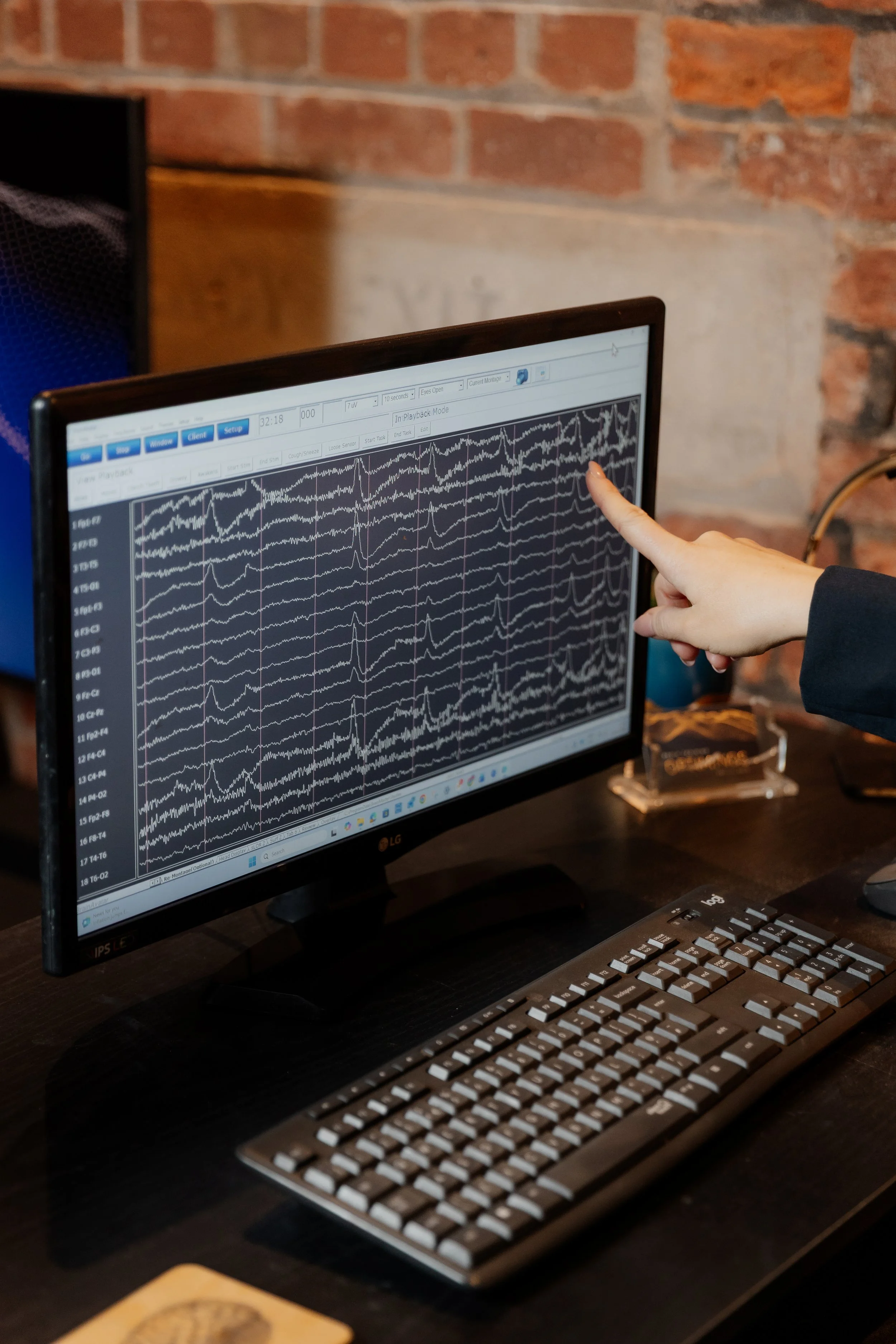
A QEEG brain map helps us see and understand how your brain is functioning - particularly how it responds to stress.
It can show:
• Overactive patterns linked to hypervigilance
• Slower or disconnected patterns linked to shutdown
• Imbalances that affect how you process and respond
• Why your brain might struggle to use logic or reasoning during times of stress
• How your brain processes and makes sense of the world around you
qeeg brain mapping for PTSD
How neurofeedback can help with ptsd
Neurofeedback works directly with the brain to help it learn a different way of functioning.
Over time, many people notice:
• Feeling calmer without trying
• Less reactivity
• More space between trigger and response
• Improved sleep
•A greater sense of safety in their body
Recent studies suggest that neurofeedback is an effective treatment for PTSD, helping to regulate brain activity and alleviate core symptoms. A 2021 clinical trial at Western University and Lawson Health Research Institute found significant symptom reductions in PTSD patients following neurofeedback treatment. Participants showed improved brain connectivity, with 61% no longer meeting the criteria for PTSD post-treatment. Neurofeedback specifically helped regulate hyperarousal and emotional dysregulation, offering promising results for long-term recovery without medication. Similar studies highlight improvements in sleep and emotional resilience.
WHAT DOES THE RESEARCH SAY?
if you or a loved one is suffering from the impact of trauma,
talk to us
At our Manchester-based practice, we offer advanced brain mapping (QEEG) and neurofeedback as effective, non-invasive modalities that can help alleviate the symptoms associated with trauma.
Contact us today to discuss how we can help.
WANT TO FIND OUT MORE?

-
If you or your child is struggling with ADHD symptoms, QEEG brain mapping and neurofeedback at Optiminds, Manchester can provide a personalised, non-invasive, and medication-free option. Schedule a free telephone consultation today to learn more about how QEEG brain mapping and neurofeedback can help improve your symptoms of ADHD.
-
Neurofeedback is a non-invasive, medication-free therapy that uses real-time monitoring of brain activity to train the brain to function more efficiently. During a neurofeedback session, sensors are placed on the scalp to measure brainwaves. Individuals engage in activities (like playing a game or watching a video) that give feedback based on their brain's activity. When the brain produces optimal brainwave patterns, the activity continues smoothly, rewarding the brain and promoting lasting changes in brain function.
-
A QEEG is a brain mapping tool that measures electrical activity in different parts of the brain, identifying areas where brainwave patterns are dysregulated.



IMPORTANT TO NOTE
At Optiminds, we do not diagnose or treat any medical or psychological conditions. Our services, including neurofeedback, are designed to support individuals by addressing specific symptoms related to attention, focus, mood, stress, sleep, and overall cognitive function. While neurofeedback has been shown to benefit many individuals with various challenges, our work focuses on improving wellness and self-regulation rather than providing medical or psychological treatment.
We encourage all clients to consult with a licensed healthcare provider for any diagnosis or treatment of medical or psychological conditions. Neurofeedback is intended to complement—not replace—any existing care plans or therapies under the guidance of your healthcare team.


SIGN UP to
OUR Newsletter